
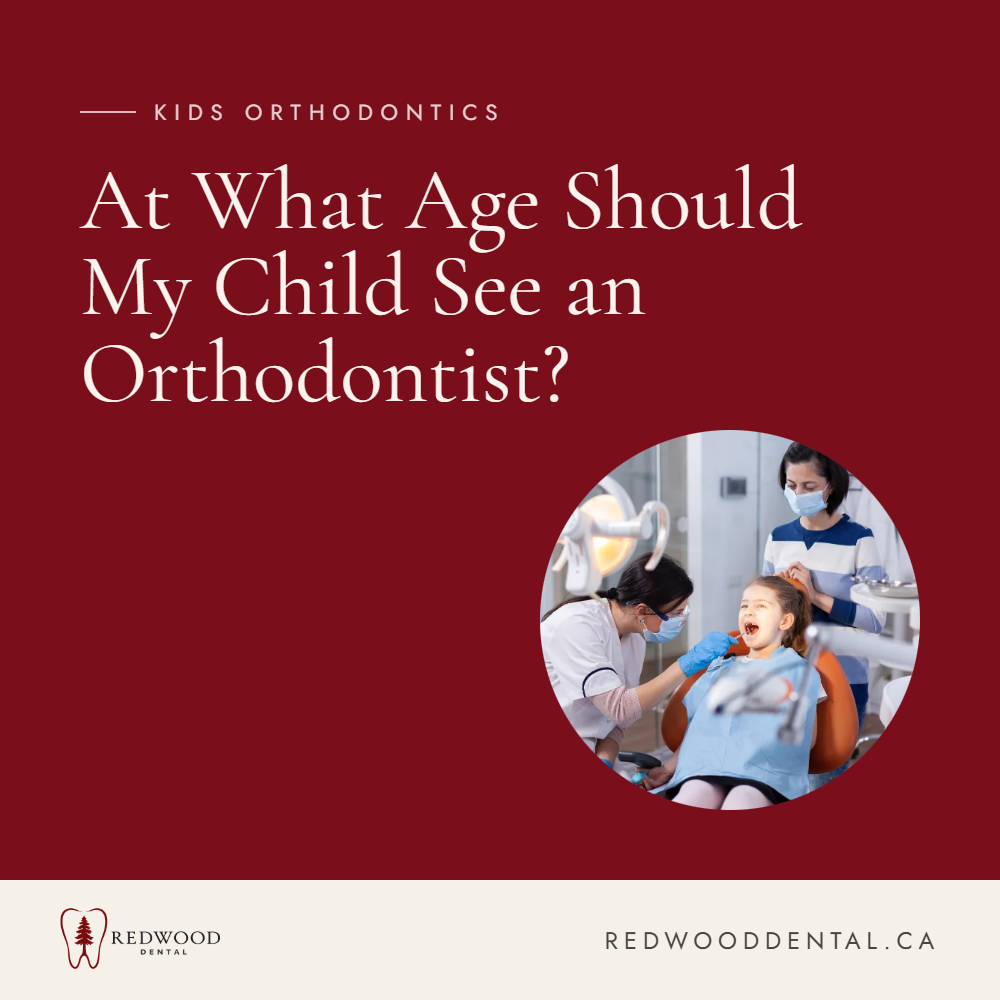
Navigating your child’s dental development can raise many questions for parents and families throughout Thunder Bay and surrounding northern communities. Understanding when to schedule a child’s first orthodontist visit is a crucial step in ensuring lifelong oral health, balanced facial symmetry, and proper jaw alignment.
At Redwood Centre Dentistry, we believe that proactive, education-driven dental care empowers families to catch developmental concerns early when they are easiest to manage.
This comprehensive educational guide explores why age seven is the recommended benchmark for an initial orthodontic assessment, breaks down mixed dentition milestones, identifies key warning signs of malocclusion, examines skeletal malocclusion classifications, explains the distinction between Phase 1 and Phase 2 treatments, details common interceptive orthodontic appliances, reviews the impact of prolonged oral habits, outlines nutritional and home care considerations, explains what to expect during a consultation, discusses long term retention, and highlights the overarching benefits of early interceptive care.
Child’s First Orthodontist Visit: Why Age Seven Is the Ideal Benchmark
The American Association of Orthodontists and the Australian Society of Orthodontists recommend that every child have an initial orthodontic evaluation by age seven. At this stage, permanent incisors and first molars have typically erupted, allowing clinicians to evaluate the bite, detect subtle skeletal discrepancies, and determine if early interceptive treatment is necessary.
Many parents assume that orthodontic care only begins once all permanent teeth have erupted in early adolescence. However, waiting until the teenage years can miss critical windows of opportunity for guiding underlying jaw growth.
By age seven, enough permanent teeth have emerged to give orthodontists a clear roadmap of how the upper and lower jaws are developing in relation to one another. Identifying skeletal discrepancies at this tender age allows specialists to direct bone growth harmoniously, avoiding complex surgical interventions or permanent tooth extractions later in life. Furthermore, evaluating jaw growth during these formative years establishes a predictable foundation for subsequent dental development.
Orthodontic Developmental Milestones Across Childhood
| Developmental Stage | Approximate Age | Key Dental & Skeletal Features | Recommended Clinical Action |
| Primary Dentition | Ages 2 to 6 | All baby teeth present; spacing is normal and healthy for future permanent teeth. | Routine pediatric dental check-ups and habit counseling. |
| Mixed Dentition | Ages 6 to 12 | Eruption of permanent incisors and first molars; mixed baby and adult teeth present. | Ideal age for first formal orthodontic evaluation (Age 7). |
| Adolescent Dentition | Ages 12 to 18 | Eruption of remaining permanent premolars, canines, and second molars. | Comprehensive Phase 2 treatment (braces or clear aligners) if indicated. |
Understanding Mixed Dentition and Dental Development Milestones
The transition from primary baby teeth to permanent teeth is known as the mixed dentition phase. This period is marked by rapid changes in arch width, bone growth, and dental alignment.
Why the Mixed Dentition Phase Matters
During ages six through twelve, the jaws undergo significant dimensional growth to accommodate larger permanent teeth. Orthodontists monitor this transition closely because it reveals whether there is sufficient skeletal space for incoming teeth.
If discrepancies arise, such as a narrow upper jaw or mismatched dental arches, early intervention can harness natural growth patterns to correct skeletal imbalances without invasive surgeries later in life. Evaluating jaw growth during these formative years allows clinicians to differentiate between simple tooth crowding and complex skeletal misalignments that involve the basal bone structure of the maxilla and mandible.
Monitoring the exfoliation sequence of primary teeth also ensures that permanent teeth erupt into their correct spatial coordinates without premature blocking or deflection.
Key Warning Signs Indicating Early Orthodontic Evaluation Is Needed
While a professional screening by age seven is recommended for all children, certain clinical indicators suggest that an evaluation should be scheduled even sooner.
Common Signs of Developing Malocclusion
- Early or Late Loss of Baby Teeth: Losing primary teeth prematurely due to decay or trauma can cause adjacent teeth to drift, blocking permanent teeth from erupting properly. Conversely, retained baby teeth can deflect incoming permanent teeth into ectopic eruption paths.
- Crossbites: When the upper teeth bite inside the lower teeth, either anteriorly or posteriorly, leading to asymmetrical jaw growth or functional shifting of the mandible during closure.
- Severe Crowding or Spacing: Overlapping teeth or excessive gaps indicate a disproportion between tooth size and available jawbone width.
- Protruding Front Teeth: Upper front teeth that stick out significantly, known as an overjet, are more susceptible to trauma during sports and active play.
- Protracted Oral Habits: Persistent thumb sucking, finger sucking, or tongue thrusting past age four can distort dental arch form and alter jaw development.
- Difficulty Chewing or Biting: Issues with biting into food or maintaining efficient mastication can point toward underlying skeletal discrepancies.
Common Malocclusion Classifications and Skeletal Discrepancies
Orthodontists categorize bite misalignments using standardized classification systems to determine whether a problem is primarily dental or skeletal in origin.
Angle Classifications of Malocclusion
| Malocclusion Classification | Clinical Description | Underlying Skeletal Relationship |
| Class I Malocclusion | Normal molar relationship, but crowding, rotation, or spacing exists in the anterior segments. | Balanced skeletal jaws with localized dental misalignment. |
| Class II Malocclusion | Upper molars sit significantly ahead of lower molars, commonly known as an overbite or retrognathia. | Maxilla is positioned forward relative to the mandible, or the mandible is underdeveloped. |
| Class III Malocclusion | Lower molars sit ahead of upper molars, commonly known as an underbite or prognathia. | Mandible is prominent relative to the maxilla, or the maxilla is restricted in forward growth. |
The Difference Between Phase 1 and Phase 2 Orthodontic Treatments
When orthodontic intervention is recommended for younger children, it is frequently divided into two distinct phases of care to maximize skeletal malleability and simplify future dental alignment.
Phase 1 (Interceptive Orthodontics)
Phase 1 treatment occurs during the mixed dentition stage, typically ages seven to ten. The primary goal is not necessarily to straighten every individual tooth, but rather to correct underlying skeletal problems, widen narrow dental arches, create room for erupting permanent teeth, and eliminate harmful functional shifts. Appliances used during Phase 1 may include rapid palatal expanders, partial braces, or custom functional appliances designed to guide bone growth.
Phase 2 (Comprehensive Orthodontics)
Phase 2 treatment takes place once all permanent teeth have erupted, usually during early adolescence, ages twelve to fourteen. Full fixed braces or custom clear aligners are applied to align all teeth into their final harmonious positions, establishing a stable, healthy bite and optimal aesthetic symmetry after the foundational skeletal work has been successfully completed.
Common Interceptive Orthodontic Appliances and Their Mechanics
During early interceptive treatment, orthodontists utilize specialized mechanical appliances designed to modify bone growth and create physical space within the developing oral cavity.
Types of Early Interceptive Appliances
- Rapid Palatal Expanders (RPE): Fixed appliances attached to the upper posterior teeth that gently widen a narrow upper jaw by separating the midpalatal suture over several weeks.
- Functional Appliances: Removable or fixed devices such as bionators or Herbst appliances that posture Thunder Bay children’s mandibles forward to stimulate harmonious lower jaw growth in Class II cases.
- Space Maintainers: Custom bands or loops placed when a baby tooth is lost prematurely, holding adjacent teeth apart so the permanent successor has an unobstructed eruption path.
- Partial Fixed Braces: Limited braces placed on permanent incisors and first molars to correct severe crossbites or severe anterior spacing during the mixed dentition phase.
What to Expect During Your Child’s First Orthodontic Consultation
Parents often worry that a child’s first orthodontic visit will involve uncomfortable procedures or immediate extractions. In reality, an initial consultation is entirely diagnostic, educational, and gentle.
The Consultation Process
- Friendly Greeting and Medical History: The clinical team welcomes your child, reviews their dental and medical history, and discusses any specific concerns you have noticed at home.
- Non-Invasive Clinical Examination: The orthodontist evaluates your child’s facial symmetry, bite alignment, jaw joint function, and the eruption pattern of primary and permanent teeth.
- Low-Radiation Digital Imaging: If necessary, low-dose digital radiographs or optical scans are captured to visualize underlying tooth roots and developing bone structures without discomfort.
- Collaborative Discussion: The clinician explains their findings in clear, understandable language, outlining whether treatment is needed immediately, whether monitoring over time is appropriate, or if no intervention is required.
To learn more about our comprehensive treatment approaches, explore our dedicated orthodontic treatments in Thunder Bay page.
The Impact of Prolonged Oral Habits on Jaw Development
Parafunctional habits during early childhood can exert continuous mechanical forces on developing alveolar bone, permanently altering dental arch dimensions.
Managing Thumb Sucking and Tongue Thrusting
While non-nutritive sucking habits are normal in infants, persisting past the age of four interferes with natural arch development. Sustained finger pressure pushes upper incisors forward while restricting transverse maxillary growth, resulting in posterior crossbites and anterior open bites. Early orthodontic evaluation can introduce gentle habit-breaking appliances that encourage proper tongue posture and lip seal development.
Nutritional and Home Care Considerations During Early Appliance Therapy
When children undergo early interceptive orthodontic treatment, maintaining immaculate oral hygiene and adapting dietary habits are essential for preventing decay and appliance breakage.
Practical Tips for Parents
- Dietary Modifications: Avoid sticky, chewy, or hard foods that can dislodge expanders or bend partial brackets. Cut hard fruits and vegetables into small, manageable pieces.
- Enhanced Brushing Techniques: Utilize specialized orthodontic toothbrushes and interdental floss threaders to remove plaque accumulation around fixed appliances daily.
- Fluoride Rinses: Incorporate dentist recommended antimicrobial or fluoride mouth rinses to protect enamel surfaces from demineralization during appliance wear.
The Long-Term Benefits of Early Interceptive Orthodontic Care
Investing in early orthodontic screening provides distinct physiological and psychological advantages that extend far beyond a straight smile.
Key Advantages of Timely Evaluation
- Guiding Facial Growth: Intercepting skeletal discrepancies early allows clinicians to steer jaw growth harmoniously, improving facial profile balance and skeletal proportions.
- Reducing Extraction Risks: Expanding narrow arches during childhood frequently creates sufficient space for permanent teeth, eliminating the need for permanent tooth extractions in adolescence.
- Minimizing Trauma Risk: Correcting protruding front teeth early protects them from accidental impact during physical activities and sports.
- Boosting Confidence: Addressing noticeable bite or alignment concerns during developmental years supports positive self-esteem as children grow.
Understanding Post-Treatment Retention and Long-Term Stability
Once active orthodontic alignment is achieved, retention is necessary to prevent teeth from migrating back toward their original positions while surrounding bone and periodontal ligament fibers reorganize.
Types of Retainers
- Removable Hawley Retainers: Custom acrylic and wire retainers that allow vertical settling of the bite while maintaining arch form.
- Clear Essix Retainers: Transparent vacuum-formed trays that offer discreet aesthetic retention.
- Fixed Bonded Retainers: Thin wire permanently bonded behind lower front teeth to prevent relapse in crowded lower incisor regions.
Partnering With Your Family Dentist on Proactive Oral Development
Orthodontic screening does not replace routine pediatric dental care; rather, it works in partnership with your regular dental check-ups.
The Collaborative Care Model
Family dentists monitor overall oral health, treat active decay, and perform routine cleanings. During these visits, your dentist can spot early signs of malocclusion and recommend when a formal evaluation is appropriate.
To ensure your child has a complete foundation in oral wellness, review our guide on preventative dental care practices. Combining consistent family dental visits with timely specialist consultations provides the highest standard of comprehensive health support, aligned with public health guidelines promoted by the Australian Society of Orthodontists and Healthdirect public health guidelines.
Frequently Asked Questions
Why is age seven recommended for a child’s first orthodontist visit?
By age seven, permanent incisors and first molars have erupted, providing orthodontists with enough developmental markers to evaluate bite alignment, detect hidden skeletal issues, and determine if early intervention will benefit jaw growth.
Does an early orthodontic evaluation mean my child will definitely need braces?
No. In many cases, the orthodontist finds that dental development is proceeding normally and simply recommends periodic observation visits as baby teeth continue to fall out and permanent teeth emerge.
What are the main signs that a child has a crossbite?
A crossbite occurs when the upper jaw is narrower than the lower jaw, causing upper teeth to bite inside the lower teeth. Parents may notice the child’s lower jaw shifting to one side when biting down.
Can thumb-sucking permanently alter a child’s jaw shape?
Yes. Prolonged thumb or finger-sucking past the age of four exerts continuous pressure on developing bone, often resulting in narrow upper arches, open bites, and protruding front teeth.
How can parents schedule an initial orthodontic assessment?
Parents can contact our team directly at Redwood Centre Dentistry to discuss developmental concerns or arrange a comprehensive initial consultation for their child.
Take the Next Step in Your Child’s Oral Health
Proactive evaluation is the key to a healthy, confident smile that lasts a lifetime. If your child is approaching age seven or you have noticed early alignment concerns, professional guidance provides clarity and peace of mind.
To schedule an initial consultation or explore our specialized services, visit our primary orthodontic treatments in Thunder Bay page or connect with our welcoming team at Redwood Centre Dentistry today.